


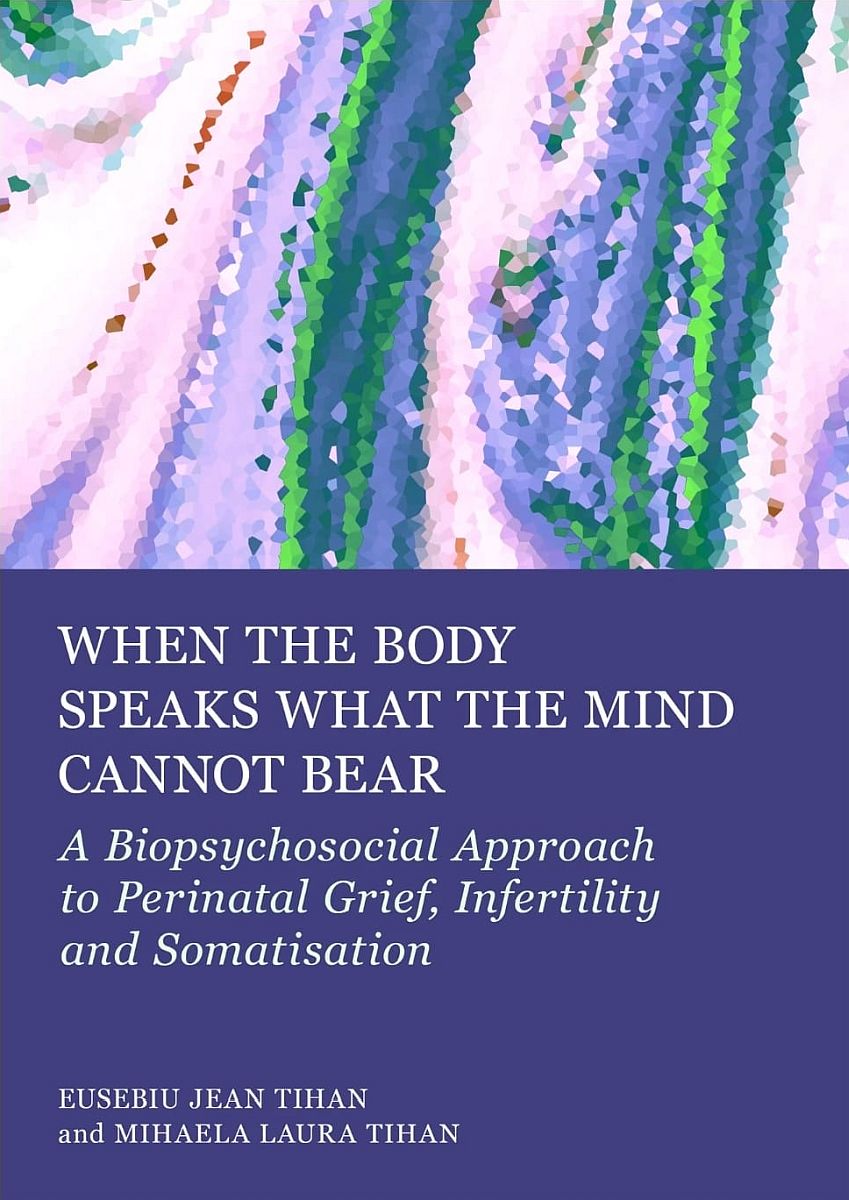
 Title: When the Body Speaks What the Mind Cannot Bear: A Biopsychosocial Approach to Perinatal Grief, Infertility and Somatisation
Authors: Eusebiu Jean Tihan and Laura Mihaela Tihan
Publisher: Ethics International Press
Publication Date: November 2026 (Forthcoming)
ISBN: 978-1-80866-195-2 (Hardback), 978-1-80866-196-9 (eBook)
Subject Classification: Psychology, Healthcare, Sociology
BIC Classification: JKSN1, MBX, VFJD
BISAC Classification: PSY022040, FAM014000, MED035000
https://ethicspress.com/products/when-the-body-speaks-what-the-mind-cannot-bear
Review
In When the Body Speaks What the Mind Cannot Bear, clinical psychologists Eusebiu Jean Tihan and Laura Mihaela Tihan present a profound and necessary contribution to the literature on grief, loss, and psychosomatic medicine. This monograph is not merely an academic text but a compassionate and rigorous exploration of a fundamental human truth often neglected by modern medicine: that grief is not confined to the mind but is profoundly embodied, manifesting in our hormones, our chronic pain, and the silent, somatic architecture of our being.
The book’s central, haunting image—a mother whose body continues to produce milk for a child who no longer exists—serves as a powerful metaphor for the entire work. It captures the core discrepancy between external reality and internal, biological expectation, a space where unprocessed pain finds a home. The authors argue compellingly that this somatization is not a pathology to be eliminated, but a message to be deciphered—a language the body speaks when the mind cannot bear the weight of the loss.
The book is structured in four distinct but interconnected parts, creating a coherent arc from the intimate and personal to the universal and political.
Part I: The Theoretical and Personal Foundation lays the groundwork with both academic rigor and disarming vulnerability. It begins with a narrative-explanatory analysis of pet bereavement (Chapter 1), a topic often dismissed but used here as a privileged model for understanding all forms of disenfranchised grief. The authors then provide a sweeping history of the epistemology of pain (Chapter 2), tracing the mind-body relationship from Hippocratic humors to Cartesian dualism and the modern synthesis of psychoneuroendocrinology. This historical context is crucial, as it establishes the authors’ central argument: the separation of mind and body is a historical and philosophical accident, not a biological reality.
The theoretical core of the book is the detailed exposition of what the authors term the “relentless triad of attachment” (Chapter 3): cortisol, oxytocin, and prolactin. Their analysis of how chronic imbalance in this neuroendocrine system underlies conditions like functional hyperprolactinemia is a major contribution. Chapter 4 focuses specifically on prolactin, arguing for its recognition not just as a lactation hormone, but as a key “translator” of psychological distress, particularly in response to captivity-type stress (humiliation, repressed anger, entrapment). This section culminates with a nuanced discussion of perinatal grief in fathers (Chapter 5), a subject that remains significantly under-researched and clinically overlooked.
Part II: Case Studies and the Dynamics of Suffering bridges theory and practice with compelling clinical narratives. Through the comparative analysis of two families (Chapter 6)—one that finds cohesion through shared grief and another that disintegrates into violence and pathology—the authors vividly illustrate the critical role of socio-cultural resources and the capacity for symbolization in determining the trajectory of mourning. The book then offers an in-depth look at the two polar trajectories of paternal grief (Chapter 7), before extending the psychosomatic model to the chronic trauma of infertility (Chapter 8) and other loss-related somatizations, from chronic pain to autoimmune disease and Takotsubo syndrome (Chapter 9).
Part III: From Theory and Story to Method and Intervention marks a decisive turn from understanding to action. Chapter 10 provides a thorough and methodologically sophisticated overview of research methods in the psychosomatics of grief, from case studies to randomized controlled trials, and proposes a detailed protocol for a future RCT. The centerpiece of this section is the “Reclaiming the Body” protocol (Chapter 11), an integrative therapeutic approach that elegantly combines psychodrama (for externalizing and negotiating with the symptom), somatic therapy (for regulating the autonomic nervous system), and EMDR (for processing traumatic images). This is followed by a robust framework for trauma-focused couples therapy (Chapter 12), identifying five major dysfunctional patterns and outlining a clear, phased intervention protocol based on Emotionally Focused Therapy (EFT).
Part IV: Context and Vision (Widening the Horizon) elevates the discussion from the clinical to the societal. Chapter 13 offers a powerful critique of the politics of disenfranchised grief, analyzing how labor laws, healthcare systems, and cultural taboos systematically invalidate certain forms of suffering. The authors propose concrete reforms, from including perinatal loss in bereavement leave to developing national hospital protocols. Chapter 14 provides a rich intercultural study, comparing the experience of perinatal grief in urban versus rural Romania and Western versus Eastern European settings, arguing that “symbolisation capacity” is the critical factor differentiating integrated grief from chronic suffering. The book concludes with an essayistic chapter (Chapter 15) that proposes a paradigm shift in our approach to suffering: from patient to person, from symptom to narrative, from cause to meaning, and from treatment to accompaniment.
Strengths of the Work
The primary strength of this book lies in its successful and ambitious integration. The authors bridge the gap between neuroendocrinology and psychoanalysis, between case study and clinical trial, and between the consulting room and public policy. This interdisciplinary synthesis is not superficial; it is built on a deep and rigorous engagement with each field.
The reflexive and personal tone is another significant strength. The authors do not claim detached objectivity; instead, they ground their work in their own experiences of loss, including the death of their beloved dog, Maya. This transparency does not weaken the book’s scientific authority but rather enhances its humanity and credibility. It is a testament to the book’s central thesis that the healer is also, inevitably, a participant in the human experience of suffering.
The “Reclaiming the Body” protocol is a highly practical and original contribution. By integrating psychodrama, somatic therapy, and EMDR in a logical, phased sequence, the authors provide clinicians with a structured yet flexible toolkit for addressing the complex, multi-level nature of psychosomatic grief. The personification of the symptom as a “Guardian of Stillness” is a particularly creative and clinically useful technique that empowers patients to negotiate with their own bodily experience.
Potential Limitations
As the authors themselves acknowledge, the “Reclaiming the Body” protocol has not yet been subjected to a randomized controlled trial. While the theoretical rationale and case studies are compelling, the field awaits empirical validation of the protocol’s efficacy. The book’s call for future research, including a detailed RCT protocol, is therefore a crucial and responsible step. Furthermore, while the book includes a valuable chapter on the Romanian context, its primary focus is on this specific cultural and institutional setting, and the applicability of its policy recommendations to other contexts may vary.
Conclusion
When the Body Speaks What the Mind Cannot Bear is a landmark work that will resonate with a wide audience. For clinicians and therapists, it offers an integrative framework and a practical toolkit for working with some of the most complex and painful forms of grief. For researchers, it provides a rich theoretical model and a clear agenda for future inquiry. For physicians, it serves as a vital reminder of the mind-body unity and the importance of listening to the patient’s story. And for bereaved parents, it offers the profound validation that their suffering is real, has a biological basis, and deserves to be recognized.
This is a book that does not offer easy answers but instead provides the tools and the courage to accompany others—and ourselves—in the difficult but meaningful process of transforming pain into memory and absence into a loyal presence. It is a call to a less cruel, more empathetic society, and a powerful reminder that healing does not mean forgetting, but learning to carry the loss without being crushed by it.
Reviewed by:
Psych. Tihan Eusebiu Jean, MSc1,2
1Tihan & Associates, Professional Civil Society of Psychology, Bucharest, Romania
2Academy of Romanian Scientists, Bucharest, Romania.
E-mail: eusebiu.tihan@gmail.com
ORCID: 0009-0008-8316-3679
Date: November 22th, 2026


Leave a Reply