


Description
Tihan Eusebiu Jean.*;
Tihan and Associates, Professional Civil Society of Psychology, Bucharest, Romania
Academy of Sciences of Romania
ORCID: https://orcid.org/0009-0008-8316-3679
Tihan Mihaela Laura¹
Tihan and Associates, Professional Civil Society of Psychology, Bucharest, Romania
ORCID: https://orcid.org/0009-0003-1820-1417
*Correspondence: Psih. Tihan Eusebiu Jean, Email: eusebiu.tihan@gmail.com;
Tihan, Eusebiu Jean; Tihan, Laura Mihaela (2026). ”The Normative Fiction and Psychic Fragmentation of the Romanian Medical System. A Transdisciplinary Analysis of Systemic “Gaps” through the Lens of Organisational Psychology, Psychological Anthropology, and National Security”, in Index Academic, II 2026, DOI: 10.58679/IA39160, https://www.indexacademic.ro/en/pdf/the-normative-fiction-and-psychic-fragmentation-of-the-romanian-medical-system/
ABSTRACT
Context. This study takes as its starting point a critical discourse published in the spring of 2026 by Dr Ciprian Maxim, entitled “One Doctor, Three Contracts, Still 24 Hours in a Day: The Gap Left Behind by Rogobete’s Order”, and analyses the structural dysfunctions of the Romanian medical system through the lens of several complementary theoretical frameworks. Ministry of Health Order no. 1,077/2026, although it introduces genuine improvements in the organisation of on-call shifts within a single hospital, fails to resolve the fundamental problem of cross-institutional monitoring of working time on the basis of the personal numeric code (CNP), continuing to treat medical staff “per contract” rather than “per individual”. This omission is not a simple technical error, but a symptom of an older institutional architecture that operates systematically by consuming human resources.
Objectives. The study pursues five interconnected objectives: (1) to reconstruct the legal mechanism through which the administrative fiction of “multiple contracts” as separate entities was constructed, in the light of CJEU case-law and European labour law; (2) to analyse, from the perspective of organisational psychology, the manner in which contractual fragmentation produces “institutional blindness”, “learned helplessness”, and “normalised deviance” among medical staff; (3) to interpret, from a psychoanalytic perspective, the unconscious mechanisms of the state apparatus that perpetuate this fragmentation — perverse denial (Verleugnung) and institutional Splitting; (4) to develop a psychological anthropology of the Romanian physician, starting from the messianic archetype and the transformation of professionalism into sacrifice; (5) to evaluate the consequences of this vulnerability for national security, through the prism of the concept of human critical infrastructure.
Methods. The study employs an integrated qualitative methodology, combining the analysis of open-source documents (legislation, CJEU case-law, European Commission reports, Court of Accounts reports), content analysis of public discourse, and discourse analysis of institutional communication, within a theoretical framework that interweaves European labour law, organisational psychology, psychoanalysis applied to institutions, and national security psychology.
Results. The analysis reveals that the administrative fragmentation of employment acts functions as a mechanism of institutional dissociation, forcing physicians towards cognitive overload and extreme exhaustion. From the perspective of organisational psychology, this fragmentation produces a form of “institutional blindness” in which each healthcare unit sees only its own fragment of reality, while local compliance generates systemic non-compliance (Vaughan, 1996)[1]. From a psychoanalytic perspective, the state appears to function through mechanisms of Verleugnung (perverse denial) and Splitting (institutional splitting), maintaining the illusion of impeccable paperwork while consuming human resources (Freud, 1927/2005)[2]. From the perspective of psychological anthropology, the Romanian physician is caught within a messianic archetype that transforms sacrifice into professional virtue and exhaustion into a badge of status. From the perspective of national security, this vulnerability transforms critical healthcare infrastructure into an asymmetric risk vector (Reason, 2000)[3].
Conclusions. The study argues for the necessity of transitioning from a punitive paradigm (deviation → control → sanction) to a preventive one (data → risk detection → warning → intervention → prevention), through the implementation of database interoperability based on the CNP, automated “hard stop” mechanisms, and independent psychoclinical screening for residents (Maslach & Jackson, 1981)[4]. The transition from “bureaucratic omertà” to “Safety Culture” is not merely a technical reform, but an anthropological recalibration of the manner in which the Romanian state understands how to protect its vital human resource.
Public Utility Statement. This study has direct relevance for public health policy, national security, and the protection of workers’ rights, offering a diagnostic framework and applicable intervention directions for preventing the exhaustion of medical staff and increasing the safety of medical practice in Romania. The results can inform policymakers, hospital managers, professional organisations, and control institutions. By translating an apparently technical problem — database interoperability — into a register of national security, the study proposes a recalibration of public policy priorities: investment in medical human resources is not a social expenditure, but a condition of systemic resilience.
Keywords: organisational pathology, safety culture, institutional splitting, learned helplessness, medical burnout, national security, interoperability, White Mafia, psychological anthropology, toxic messianism.
Ficțiunea normativă și fragmentarea psihică a sistemului sanitar românesc. O analiză transdisciplinară a „lacunelor” sistemice prin prisma psihologiei organizaționale, a antropologiei psihologice și a securității naționale
REZUMAT
Context. Prezentul studiu pornește de la un eseu critic publicat în primăvara anului 2026 de dr. Ciprian Maxim, intitulat „Un medic, trei contracte, mereu 24 de ore într-o zi: lacuna lăsată de Ordonanța Rogobete”, și analizează disfuncționalitățile structurale ale sistemului sanitar românesc în lumina mai multor cadre teoretice complementare. Ordonanța Ministerului Sănătății nr. 1.077/2026, deși introduce îmbunătățiri concrete în organizarea turelor de gardă în cadrul unui singur spital, nu reușește să rezolve problema fundamentală a monitorizării interinstituționale a programului de lucru pe baza codului numeric personal (CNP), continuând să trateze personalul medical „pe bază de contract”, mai degrabă decât „pe bază de persoană”. Această omisiune nu este o simplă eroare tehnică, ci un simptom al unei arhitecturi instituționale de lungă durată, care funcționează sistematic prin exploatarea resurselor umane.
Obiective. Studiul urmărește cinci obiective interconectate: (1) reconstituirea mecanismului juridic prin care a fost construită ficțiunea administrativă a „contractelor multiple” ca entități separate, în lumina jurisprudenței Curții de Justiție a Uniunii Europene (CJUE) și a dreptului muncii european; (2) să analizeze, din perspectiva psihologiei organizaționale, modul în care fragmentarea contractuală generează „orbire instituțională”, „impotență învățată” și „deviere normalizată” în rândul personalului medical; (3) interpretarea, dintr-o perspectivă psihanalitică, a mecanismelor inconștiente ale aparatului de stat care perpetuează această fragmentare — negarea perversă (Verleugnung) și scindarea instituțională; (4) elaborarea unei antropologii psihologice a medicului român, pornind de la arhetipul mesianic și de la transformarea profesionalismului în sacrificiu; (5) evaluarea consecințelor acestei vulnerabilități asupra securității naționale, în lumina conceptului de infrastructură critică umană.
Metode. Studiul utilizează o metodologie calitativă integrată, care combină analiza documentelor provenite din surse deschise (legislație, jurisprudența Curții de Justiție a Uniunii Europene, rapoarte ale Comisiei Europene, rapoarte ale Curții de Conturi), analiza conținutului discursului public și analiza discursului din comunicarea instituțională, într-un cadru teoretic care îmbină dreptul muncii european, psihologia organizațională, psihanaliza aplicată instituțiilor și psihologia securității naționale.
Rezultate. Analiza evidențiază faptul că fragmentarea administrativă a actelor de angajare funcționează ca un mecanism de disociere instituțională, obligând medicii să se confrunte cu o suprasolicitare cognitivă și o epuizare extremă. Din perspectiva psihologiei organizaționale, această fragmentare produce o formă de „orbire instituțională” în care fiecare unitate medicală vede doar propria sa fracțiune de realitate, în timp ce respectarea normelor la nivel local generează o nerespectare sistematică a acestora (Vaughan, 1996). Dintr-o perspectivă psihanalitică, statul pare să funcționeze prin mecanisme de Verleugnung (negare perversă) și Splitting (scindare instituțională), menținând iluzia unei documentații impecabile în timp ce consumă resurse umane (Freud, 1927/2005). Din punctul de vedere al antropologiei psihologice, medicul român este prins într-un arhetip mesianic care transformă sacrificiul în virtute profesională și epuizarea într-un simbol al statutului. Din punctul de vedere al securității naționale, această vulnerabilitate transformă infrastructura sanitară critică într-un vector de risc asimetric (Reason, 2000).
Concluzii. Studiul susține necesitatea trecerii de la o paradigmă punitivă (încălcare → control → sancțiune) la una preventivă (date → identificarea riscului → alertă → intervenție → prevenire), prin implementarea interoperabilității bazelor de date bazate pe CNP, a mecanismelor automate de „blocare forțată” și a screeningului psihoclinic independent pentru rezidenți (Maslach & Jackson, 1981). Trecerea de la „omertă birocratică” la „cultura securității” nu este doar o reformă tehnică, ci o recalibrare antropologică a modului în care statul român concepe
I. INTRODUCTION
1.1. Context and Research Problem
The Romanian medical system has been confronting a structural staffing crisis for decades, the effects of which bear directly upon patient safety and upon the mental health of medical staff. Within this context, the emergence of Ministry of Health Order no. 1,077/2026, signed by State Secretary Alexandru Rogobete, has brought back into public attention a systemic problem of particular gravity: the technical and legal impossibility for the state to monitor the total working time of a physician operating under multiple contracts, with different employers.
The present analysis takes as its starting point a critical discourse published by Dr Ciprian Maxim in the spring of 2026, entitled “One Doctor, Three Contracts, Still 24 Hours in a Day: The Gap Left Behind by Rogobete’s Order”. This text does not represent a mere reaction of professional revolt, but a veritable manifesto of civic resistance and a clinical diagnosis applied to the state administrative apparatus.
Maxim’s discourse deconstructs a recent normative act through a rhetorical strategy based on a fundamental antithesis: the biological reality of the human organism versus the scriptural fiction of bureaucratic accountancy. The author employs a technical-legal tone, yet one profoundly marked by subversive irony, unmasking the manner in which the state operates an artificial dissociation of the individual. Through the phrase “changing the contract does not reset his clock”, the political discourse of the text highlights a form of institutionalised magical thinking: the belief that the issuance of a new legal document replenishes the cognitive and physical resources of a physician exhausted after a 24-hour on-call shift.
From our perspective, this discourse analysis reveals a major fracture in the public communication of health authorities. Rogobete’s Order presents itself as an instrument of control and transparency (mandating the traceability of monthly on-call schedules), yet manifests a selective blindness. It stops precisely where macro-systemic responsibility begins: the interconnection of databases. This fragmentary approach in political communication and legislation in fact conceals a strategy of scapegoating, shifting blame from the ministry level to the local management of hospitals, leaving unresolved the “gap” through which national and individual security leaks away.
1.2. Novelty Statement
The novelty of this study consists in the integration of five distinct theoretical perspectives — European labour law, organisational psychology, psychoanalysis applied to institutions, psychological anthropology, and national security psychology — into a unitary explanatory framework, capable of describing and explaining the mechanism through which a modern state can function systematically by consuming human resources, without being sanctioned or corrected.
The specialised literature has treated separately the problem of medical burnout (Maslach & Jackson, 1981)[5], of staff shortage (Reason, 2000)[6], or of the quality of medical practice (Landrigan et al., 2004)[7]. The present study proposes a transdisciplinary synthesis that identifies the common root of these symptoms: assisted institutional splitting — a mechanism through which the state consciously tolerates two parallel realities (the legal one, impeccable on paper, and the biological one, exhausting for the physician) and uses it as a safety valve to avoid the financial collapse of the public health system.
1.3. Methodological Positioning and Epistemological Limits
The study is situated within the paradigm of transdisciplinary qualitative research, with a critical-interpretive orientation. No statistical validity or generalisation of conclusions to the level of the entire Romanian medical system is claimed. On the contrary, the exploratory and hypothetical character of certain proposed concepts (“Assisted Institutional Dissociation Syndrome”, “White Mafia” as an analytical metaphor, “human critical infrastructure”, “toxic messianism”) is explicitly acknowledged.
Furthermore, it is acknowledged that the psychoanalytic interpretation of institutions does not constitute a clinical diagnosis of persons or organisations, but an instrument of symbolic reading of the unconscious mechanisms that structure collective behaviour (Freud, 1927/2005)[8]. The concepts of “institutional mafiotisation” and “White Mafia” are employed with caution, as analytical metaphors, and not as factual assertions regarding the existence of organised criminal structures. In the same sense, the psychological anthropology developed here does not claim to be an exhaustive ethnography of the Romanian physician, but an interpretive schema that may be refined through further research.
II. METHODS
2.1. Study Design
The study employs an integrated qualitative methodology, with three distinct methodological components, each with a precise analytical intention.
The first component — analysis of open-source documents — has as its intention the reconstruction of the legal and institutional framework of the problem. We chose to analyse legislative texts (Order no. 1,077/2026, the Labour Code, Directive 2003/88/EC) in order to identify what the law provides and what it omits to provide. We included CJEU case-law (Case C-585/19) in order to establish the European standard regarding the global calculation of working time. The European Commission reports (2023) and those of the Court of Accounts were selected in order to highlight the discrepancy between Romania’s formal commitment and actual practice. Ministry of Health communications were analysed in order to capture the manner in which the authority constructs its public discourse about its own reform. This component is not a simple inventory of documents, but an anatomy of silences — what official documents do not say is just as important as what they do say.
The second component — content analysis — has as its intention the identification of recurring patterns in public discourse about medical exhaustion. We chose Dr Ciprian Maxim’s discourse because it is not a simple opinion piece, but a documented synthesis of a systemic problem. Media materials concerning the cases at Târgu Jiu, Timișoara, and “Sfântul Pantelimon” Hospital were selected in order to illustrate the concrete human consequences of the systemic “gap”. We did not seek the sensational, but the correlation between a deficit of institutional architecture and individual tragedies.
The third component — discourse analysis — has as its intention the dismantling of the rhetorical mechanisms through which authorities construct their legitimacy and transfer their responsibility. We applied Fairclough’s grid (1995)[9] in order to analyse strategies of nominalisation (who is named as responsible?), modalisation (what is presented as necessity versus possibility?), and transitivity (who acts and who is acted upon?). This component is not a simple critique of communication, but a radiography of the power relations that structure public discourse about health.
2.2. Conceptual Instruments
- Organisational psychology: Argyris’s model of blocked learning (Argyris, 1990)[10], the concept of the “double bind” (Bateson et al., 1956)[11], Seligman’s model of learned helplessness (Seligman, 1972)[12], the concept of the “normalisation of deviance” (Vaughan, 1996)[13].
- Psychoanalysis applied to institutions: the concepts of perverse denial (Verleugnung), splitting (Splitting), projection, and repetition compulsion (Freud, 1927/2005; Klein, 1946/1975)[14].
- National security psychology: the concept of critical infrastructure, systemic resilience, asymmetric risk, Safety Culture (Reason, 2000)[15].
- European labour law: the principle of the uniqueness of the natural person, the global calculation of working time (CJEU C-585/19)[16].
- Psychological anthropology: the concept of the archetype (Jung, 1959/1997)[17], the theory of sacrifice (Girard, 1972/1995)[18], the cultural analysis of messianism (Eliade, 1957/1994)[19].
III. RESULTS
3.1. Synthesis of the Specialised Literature
The specialised literature reveals a strong correlation between sleep deprivation, professional exhaustion, and diminished cognitive performance among medical staff (Reason, 2000; Maslach & Jackson, 1981)[20]. International studies have demonstrated that physicians working shifts longer than 24 hours have a significantly higher risk of committing medical errors (Landrigan et al., 2004)[21]. In Romania, research on medical burnout has focused primarily on the prevalence of the syndrome, without investigating the organisational and institutional mechanisms that produce and perpetuate it.
3.2. Results of the Qualitative Analysis
- The Legal Mechanism of Fragmentation
The analysis reveals that CJEU Case C-585/19 (Bucharest University of Economic Studies) established a fundamental principle: where multiple contracts exist with the same employer, working time and rest periods are calculated globally, for all contracts taken together (CJEU, 2021)[22]. The Court characterised the practice of treating contracts separately as a legal fiction contrary to the biological reality of the worker.
However, the European Commission’s 2023 report explicitly recorded that Romania continues to apply limits per contract when employers are different, despite the recommendation to apply limits per worker (European Commission, 2023)[23]. This inconsistency is not a simple technical error, but an implicit political choice not to invest in database interoperability.
Order no. 1,077/2026 introduces genuine improvements at the level of a single hospital (traceability of on-call shifts, prohibition of consecutive shifts, obligation to record hours in both the attendance register and the timesheet), but stops at the hospital gate. It does not create the mechanism through which hours actually worked for different employers are automatically correlated on the same CNP (Ministry of Health, 2026)[24].
- The Psychosocial Dimension: “White Mafia” as a Survival Mechanism
Discourse and content analysis of media materials reveals a repetitive pattern: in hospitals with chronic staff shortages, informal networks of complicity develop between management, department heads, and physicians, based on:
- Bureaucratic omertà: tacit acceptance of fictitious timesheets, impossible overlaps, and violation of rest periods.
- Collective institutional capture: physicians accept the game because of a psychological ambivalence — on the one hand they experience severe exhaustion, on the other they benefit from the multiplication of income through the accumulation of functions. Thus, the system buys the complicity of its victims.
- “White Mafia” becomes a symbiotic structure between oppressor and oppressed, both feigning legality on paper while sabotaging biological reality.
- Psychoanalytic Significations of State Bureaucracy
Perverse denial (Verleugnung). In classical psychoanalytic terms, the mechanism employed by state bureaucracy is a pure form of perverse denial (Freud, 1927/2005)[25]. The psychic formula of this mechanism is: “I know very well that this is so (that a human being is a single biological entity, that he needs rest in order not to kill a patient by mistake), but nevertheless I continue to act as if it were not so (I calculate his working time per contract, not per worker).”
This is not simple ignorance or incompetence; it is a perverse structure in which the law is used fetishistically. Rogobete’s Order functions as a bureaucratic fetish: its presence in the Official Gazette serves to cover, to deny symbolically, the castration/lack of power of the system to generate a real reform. The state defends itself against the reality of the physician shortage by producing perfect paperwork.
Splitting as a psychotic mechanism of the state. We are witnessing a profound institutional splitting, similar to the defence mechanisms found in psychoses (Klein, 1946/1975)[26]. The Romanian state suffers from a dissociation between two egos:
- The Ideal European Ego: The one that signs treaties, reports progress to the European Commission in 2023, mimics digitalisation through REGES, and adopts ordinances formally aligned with CJEU standards.
- The Subterranean Real Ego: The one that permits two physicians at Borșa Recovery Hospital to cover 90.3% of on-call shifts in a month, the one that knows that if an algorithm for automatic blocking of timesheets based on the CNP were introduced tomorrow, half of the provincial hospitals in Romania would instantly freeze.
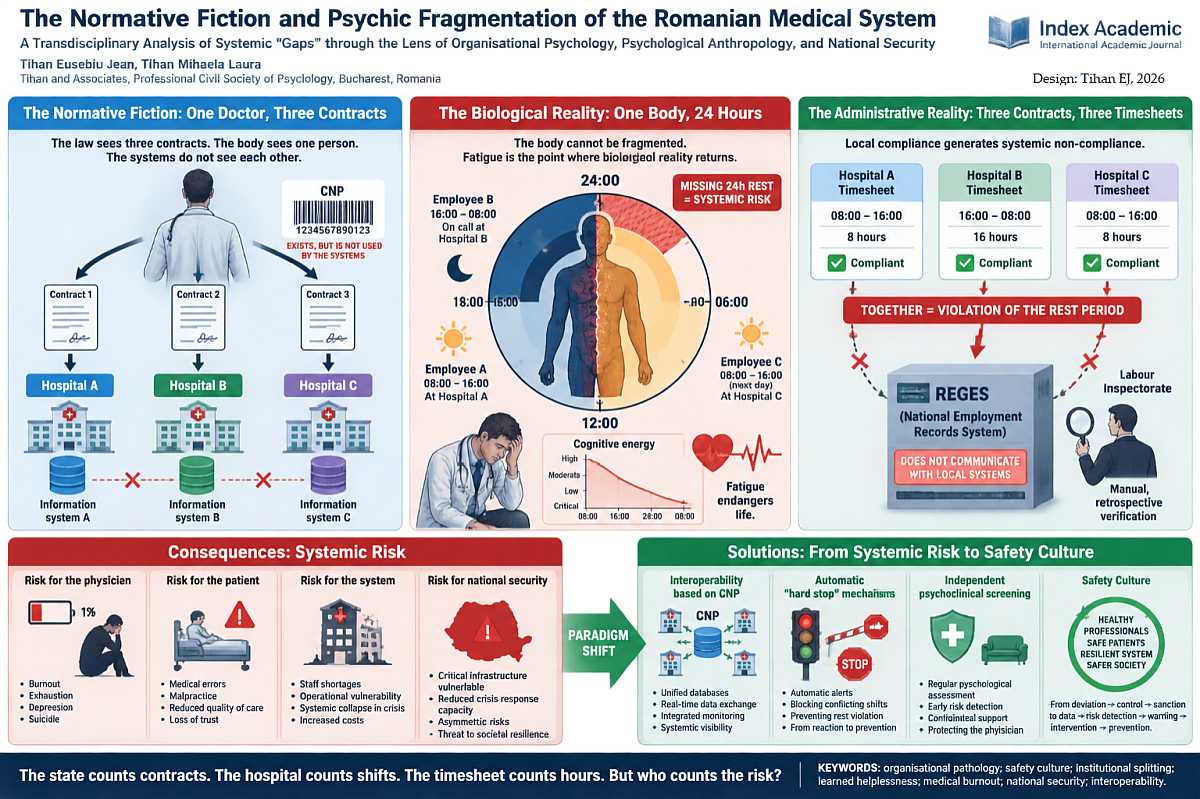
This structural splitting is projected onto the physician, who is forced to fragment himself psychically: between 08:00 and 16:00 he is “Employee A” eager for performance, on call he becomes “Employee B” exhausted, and the next day at another hospital he becomes “Employee C”, hoping that no lapse of attention will destroy his career.
- Psychology Applied to National Security: Health as Critical Infrastructure
From the perspective of psychology applied to national security, the public health system represents not merely a provider of social services, but a pillar component of critical infrastructure, directly responsible for maintaining the neuro-psychic and physical resilience of the population (Reason, 2000)[27]. The sabotage, even through administrative omission, of this structure equates to an asymmetric vulnerability of state security.
When Order no. 1,077/2026 or REGES mechanisms refuse cross-institutional correlation of working time on the basis of the CNP, the Romanian state legalises, de facto, operation under conditions of extreme cognitive vulnerability. In military and security psychology, chronic sleep deprivation (crossing the threshold of 24 hours of active wakefulness) is equivalent to a major risk factor for decision errors, delayed reactions, and collapse of critical judgement.
Dissolution of trust in the state and undermining of population resilience. National resilience is built upon an unwritten psychological contract between the citizen and state institutions. When the population perceives that the medical system is an administrative “Russian roulette” — where the patient’s life depends on the exhaustion level of a physician forced to juggle three contracts — the phenomenon of social anomie appears (Durkheim, 1897/1993)[28]. The decline of trust in institutions destroys social cohesion, leaving the population vulnerable to manipulation, panic, and disinformation.
- Organisational Psychopathology: Learned Helplessness and Normalised Deviance
Learned helplessness syndrome. Martin Seligman’s theoretical model of learned helplessness (Seligman, 1972)[29] applies perfectly to the manner in which the Romanian medical system modulates and controls its young human resource. The resident or young specialist enters the hospital with a high set of ethical values and a desire for performance. Subsequently, he encounters the reality described in the text: understaffed on-call lines, the unwritten obligation to perform unpaid shifts or to take on multiple contracts in satellite hospitals in order to cover the staffing “gaps” of management.
When their attempts to report fatigue, staff shortages, or non-compliance with rest periods are met with administrative punishments, marginalisation, or the historic retort “if you don’t like it, leave, there are plenty at the gate”, learned helplessness becomes installed. The physician understands that no personal action can change the outcome.
From exhaustion to tragedy: normalisation of deviance and cases from the press. Our research cannot ignore the direct correlation between this organisational psychopathology and the human tragedies that have shaken the public space in recent years, cases that demonstrate that the systemic “gap” produces victims on both sides of the medical act:
- The tragedy at Târgu Jiu County Emergency Hospital (the case of the Cardiology resident): the sudden death of a young resident physician during a night shift, occurring against a background of extreme physical exhaustion. This case exposed the manner in which residents are used as cheap labour to sustain on-call lines that senior physicians refuse.
- The phenomenon of suicides among young physicians (the case at Timișoara County Hospital): the suicide of a resident physician in the Anaesthesia and Intensive Care (ICU) department, a department in permanent staff deficit. The press documented an infernal work rhythm, with shifts frequently exceeding legal limits and enormous psychological pressure.
- The case of “Sfântul Pantelimon” Hospital, Bucharest: although investigated on aspects of malpractice and department management, from a psychosocial point of view this scandal conceals the same pathology of exhaustion and desperate “moral triage”. When resources are under-dimensioned, staff develop a form of extreme emotional detachment as a survival mechanism (Vaughan, 1996)[30].
- Specific Concepts Proposed
- Assisted Institutional Dissociation Syndrome (AIDS): defined as the conscious toleration by the state apparatus of two parallel realities (the impeccable REGES versus the exhausted body of the physician). The state not only assists in this dissociation, but uses it as a safety valve to avoid the financial collapse of the public health system.
- The psychic economy of sacrifice: the replacement of management based on real resources with management based on the exploitation of the psychic and biological capital of employees. Romanian hospitals function not on flexible budgets, but on the continuous crediting that physicians extend to the system by surrendering their hours of sleep.
- Silent bureaucratic terrorism: the manner in which apparently well-intentioned regulations (such as Rogobete’s Order) in fact increase bureaucratic terror (controls, multiple timesheets, registers), without providing the real instrument of protection (interoperability). The result is the blocking of the physician’s reflex of revolt.
IV. THE PSYCHOLOGICAL ANTHROPOLOGY OF THE ROMANIAN PHYSICIAN
4.1. The Messianic Archetype and Self-Sacrifice
In order to understand why an information system such as REGES-ONLINE refuses to raise the “red flag” when the same CNP is clocked simultaneously or successively in three different hospitals, it is necessary to descend into the deep strata of the psychological anthropology of the Romanian space. At the base of the organisational culture of Romanian hospitals there resists a dangerous cultural archetype: the Physician as Sacrificed Hero. The roots of this collective behaviour are of an anthropological-religious nature, where professional competence is socially validated only if accompanied by physical suffering and privation. “To resist” on the barricades, to perform consecutive shifts, to work until collapse becomes a rite of passage and an emblem of status. This cultural normalisation of biological abuse provides the state with the perfect fuel to perpetuate the staffing deficit. Trauma and exhaustion are internalised by the medical body not as dysfunctions, but as professional virtues.
This observation may be theorised through the concept of toxic messianism — a form of cultural adaptation in which the physician takes upon himself the responsibility for the functioning of a defective system, transforming his own exhaustion into proof of devotion. Toxic messianism is not an individual choice, but a cultural matrix transmitted through medical education, through mentoring relationships, through public discourse about “vocation” and “sacrifice”.
4.2. The Transformation of Professionalism into Sacrifice
The question then becomes deeper: what type of professional behaviour does a system produce in which sacrifice is associated with vocation? A progressive transformation may appear: professionalism → vocation → sacrifice → over-responsibilisation → exhaustion → cynicism → adaptation. The physician who resists becomes the reference model. The one who says “I can no longer” may be perceived as uncommitted or uncollegial. Thus, the organisation may come to select and implicitly reward self-sacrificial behaviours. It is no longer merely a question of the exploitation of time. It is a question of redefining professional value through the capacity to endure what the organisation cannot resolve.
4.3. The Body as the Locus of the System’s Contradictions
A psychoanalytic reading must here be presented as symbolic interpretation, not as clinical diagnosis of persons or institutions. The contract may symbolise legal fragmentation. The timesheet may symbolise the institution’s attempt to control and measure time. The body, however, remains that which cannot be fragmented. Fatigue is the point at which biological reality re-enters the system and contests the administrative fiction. The physician’s body thus becomes the place where the contradictions of the system are, ultimately, settled.
4.4. From the Anthropology of Suffering to the Anthropology of Resilience
This anthropology of suffering is not a fatality. It may be transformed through a cultural recalibration that shifts the centre of gravity from “how much can you endure” to “how much can the system protect”. The transition from a culture of sacrifice to a culture of shared responsibility presupposes, however, a profound change in the manner in which Romanian society understands medical vocation, professional success, and the relationship between the individual and the institution.
V. THE PSYCHOSOCIAL FACTORS OF THE CONSTRUCTION OF THE “WHITE MAFIA”
5.1. The Genesis and Dynamics of the “White Mafia” as a Survival Pact
The term “White Mafia”, used in this context, must not be understood strictly in its criminal-financial sense, but as a defensive psychosocial construct, a subterranean network of complicity created to manage a hostile environment and a chronic resource deficit officially recognised as early as 2016. When the state consciously leaves a legal breach (the possibility of accumulating cross-institutional contracts without centralised CNP control), it forces actors within the system to develop pathological adaptation strategies.
5.2. Bureaucratic Omertà
Hospital managers, medical directors, and department heads become captives within an unwritten agreement. In order for Hospital A and Hospital B not to close their on-call lines, fictitious timesheets, impossible temporal overlaps, and violations of the 24-hour rest period are tacitly accepted. Bureaucratic omertà is not a conspiracy, but an emergent result of a situation in which all actors know that strict compliance with the law would lead to the collapse of the system. Silence thus becomes a form of diffuse responsibility — no one is guilty, yet all are complicit.
5.3. Collective Institutional Capture
Physicians themselves accept this game because of a psychological ambivalence: on the one hand they experience severe exhaustion, on the other they benefit from the multiplication of income through the accumulation of functions. Thus, the system buys the complicity of its victims. The “White Mafia” becomes a symbiotic structure between oppressor and oppressed, both feigning legality on paper while sabotaging biological reality. This dynamic explains why technical reforms (such as Rogobete’s Order) do not produce the expected change: they do not touch the psychosocial pact that structures collective behaviour.
5.4. Group Loyalty and Mutual Dependence
Another essential psychosocial factor is group loyalty. In hospitals with staff shortages, the informal cohesion of the team becomes a survival mechanism. The physician who refuses to take on an additional shift is not seen merely as an individual, but as a traitor to the group. This vertical loyalty (towards the chief) and horizontal loyalty (towards colleagues) creates a network of reciprocal debts that makes any attempt to strictly comply with the law extremely costly.
5.5. Normalisation of Deviation and Mutual Dependence
Mutual dependence between management and key personnel creates a vicious circle: the manager needs the “indispensable” physician to cover the shift; the physician needs the manager to preserve his status and income. Each party has an interest in maintaining the status quo, even if it consumes human resources. Deviation becomes the informal norm, and conformity with the law becomes a costly exception.
VI. THE INDISPENSABLE PERSON — WHEN SACRIFICE BECOMES INFRASTRUCTURE
6.1. The Paradoxical Mechanism of Deficit
In many organisations a paradoxical mechanism appears: staff deficit transforms certain employees into indispensable people; indispensability produces dependence; dependence justifies the toleration of overload; overload perpetuates vulnerability. The schema may be described simply: deficit → overload → indispensability → dependence → toleration of the exception → perpetuation of the deficit. In this model, individual sacrifice is no longer a temporary solution. It becomes an informal component of the organisation’s infrastructure.
6.2. The Consumption of Human Resilience
A system that functions only because certain persons accept very high personal costs is not a resilient system. It is a system that consumes its own human resilience. This distinction is crucial: resilience is not the capacity to endure indefinitely, but the capacity to adapt and regenerate. A system that depends on individuals who cannot regenerate is, by definition, a fragile system.
6.3. The Borșa Case — An Empirical Illustration
In December 2025, on the Internal Medicine on-call line at Borșa Recovery Hospital, Dr Oana Maria Andreica appears in 14 shifts, and Dr Ileana Dincă in another 14. Two female doctors cover 28 of the month’s 31 shifts, that is, 90.3%. This figure does not by itself demonstrate illegality. It does, however, indicate a level of concentration that justifies a risk analysis: full schedule, rest, other contracts, distribution of responsibilities, and replacement capacity. The real question is not only “how much do these people work?”, but also “what happens to the organisation if they can no longer?”
VII. THE ORGANISATIONAL CULTURE OF THE EXCEPTION
7.1. Informal Norms vs. Written Procedures
Laws are not the only things that produce behaviour. In organisations there exist informal norms, reciprocal expectations, and professional rituals that may become more powerful than written procedure. Expressions such as “we have no one else”, “we must cover the line”, “everyone does this”, or “if he leaves, we are left uncovered” can function as mechanisms for normalising the exception.
7.2. From Exception to Normality
Over time, the rule is perceived as the ideal, the exception becomes practice, and practice becomes the new normality. This is a form of cultural resistance of the system: the organisation does not necessarily formally reject the rule, but learns to absorb it without changing its underlying behaviour. The result is a dual system: a formal system of written rules, and an informal system of real practices. Any reform that does not touch the informal system is doomed to failure.
7.3. Rituals of Legitimising the Exception
The exception is not imposed brutally. It is accompanied by rituals of legitimisation: meetings at which it is “established” that no alternatives exist; informal discussions at which it is “acknowledged” that the ideal solution is not possible; moments of “sacrifice” in which someone accepts the additional shift as an act of collegial heroism. These rituals transform the exception from a deviation into an organisational virtue.
VIII. FROM GROUP CULTURE TO INSTITUTIONAL “MAFIOTISATION”
8.1. Conceptual Precautions
The term “White Mafia” must be used with caution. Without evidence regarding the existence of an organised criminal structure, it must not be presented as a factual finding. It may, however, be used as an analytical metaphor for a process of institutional mafiotisation: the formation of informal networks in which loyalty, reciprocity, group protection, silence, and mutual dependence come to influence the functioning of the institution.
8.2. Relevant Mechanisms
The relevant mechanisms may be: group loyalty, informal exchange of favours, organisational silence, normalisation of deviation, mutual dependence between management and key personnel, and externalisation of responsibility. What is important is that participants need not perceive themselves as members of a “mafia”. A clientelist system can function through people who consider themselves, subjectively, merely collegial, supportive, or pragmatic.
8.3. From Metaphor to Institutional Reality
Even if the “White Mafia” is not a formal structure, its effects are real: blocking of reforms, protection of incompetence, discouragement of reporting, perpetuation of deficit. From a psychosocial perspective, this dynamic is sufficiently powerful to explain why an evident problem can persist for years without being resolved.
IX. A PSYCHOANALYTIC READING: THE BODY THAT PAYS
9.1. The Contract as Symbol of Fragmentation
The contract may symbolise legal fragmentation. The timesheet may symbolise the institution’s attempt to control and measure time. The body, however, remains that which cannot be fragmented. This triple structure — contract, timesheet, body — may be read as a metaphor of the relationship between administrative fiction and biological reality.
9.2. Fatigue as the Point of Return of the Real
Fatigue is the point at which biological reality re-enters the system and contests the administrative fiction. The physician’s body thus becomes the place where the contradictions of the system are, ultimately, settled. This psychoanalytic reading is not a diagnosis, but a symbolic interpretation of the manner in which the system transfers its costs onto individuals.
9.3. Institutional Repetition Compulsion
Another useful psychoanalytic concept is repetition compulsion. The system repeats the same mistakes — derogation that expires (2016), CJEU finding (2021), European Commission report (2023), partial order (2026) — because it does not process the fundamental trauma: the recognition that the staffing deficit cannot be resolved through individual sacrifice. Each partial solution is a resistance to real change.
9.4. The Institutional Superego
The message of the institutional superego is: “The good physician is the one who does not complain, who covers the gaps, who does not ask for rest.” The effect is the internalisation of guilt and anxiety. The physician becomes his own supervisor. The consequence is that the system does not need to sanction; the physician sanctions himself.
X. FROM ORGANISATIONAL PSYCHOLOGY TO SECURITY AND RESILIENCE
10.1. National Security Does Not Mean Securitising Every Problem
To speak of national security does not mean transforming every management problem into a strategic threat. It means observing how local vulnerabilities can transform, under certain conditions, into systemic vulnerabilities. A healthcare system dependent on key individuals, with reduced redundancy, fragmented information, and informal solutions is more vulnerable to major shocks: epidemics, disasters, staffing crises, or other situations that sharply increase demand for medical services.
10.2. The Fragility of Apparently Functional Systems
A system that permanently consumes the energy reserve of its personnel may appear functional in normal periods and may become fragile precisely when society has the greatest need of it. This observation is crucial: fragility is not visible in periods of calm, but in moments of crisis. A system that functions “at the limit” in normal conditions will collapse at the first significant overload.
10.3. Human Critical Infrastructure
The hospital is infrastructure. But physical infrastructure does not function without people. In this sense, medical personnel may be viewed as a form of human critical infrastructure: a resource that maintains the system capable of responding to demands. If two persons cover an overwhelming proportion of the shifts of a specialty, the figure does not by itself demonstrate illegality. It does, however, indicate a level of concentration that justifies a risk analysis: full schedule, rest, other contracts, distribution of responsibilities, and replacement capacity.
XI. FROM CONTROL TO PREVENTION
11.1. The Current Paradigm: Deviation → Control → Sanction
A mature system should not discover the problem only after the occurrence of an incident or after an inspector manually reconstructs a person’s schedule. It should be able to correlate, with the necessary legal and data protection guarantees: professional identity, contracts, employers, planned hours, hours actually worked, shifts, rest periods, and possible overlaps.
11.2. The Proposed Paradigm: Data → Risk Detection → Warning → Intervention → Prevention
The aim should not be the automatic punishment of the physician who works in several places. The aim should be the early detection of situations in which the accumulation of schedules may create risk for the physician or the patient. This means transitioning from the paradigm deviation → control → sanction to the paradigm data → risk detection → warning → intervention → prevention.
11.3. Interoperability as a National Security Imperative
Unification of databases: automatic real-time correlation of all individual employment contracts, service provision contracts (shifts), and timesheets from public and private hospitals on the basis of the physician’s CNP, not “per contract”.
Early warning system (the “red flag”): automatic notification of the Labour Inspectorate and risk management departments at the moment when a physician exceeds the maximum working time established by European directives.
11.4. The Principle of Just Culture
In aviation, error is not viewed as an individual fault, but as a symptom of a system defect (Reason, 2000)[31]. The physician must have the legal right and the deontological obligation to “stop the engines” when their biological indicators show exhaustion.
XII. THE PHYSICIAN AS HUMAN CRITICAL INFRASTRUCTURE
12.1. Recognition of Structural Vulnerability
The hospital is infrastructure. But physical infrastructure does not function without people. In this sense, medical personnel may be viewed as a form of human critical infrastructure: a resource that maintains the system capable of responding to demands. If two persons cover an overwhelming proportion of the shifts of a specialty, the figure does not by itself demonstrate illegality. It does, however, indicate a level of concentration that justifies a risk analysis: full schedule, rest, other contracts, distribution of responsibilities, and replacement capacity.
12.2. The Real Question
The real question is not only “how much do these people work?”, but also “what happens to the organisation if they can no longer?” This question shifts the analysis from the individual to the system, and from morality to security.
12.3. Redundancy as a Security Principle
In critical systems, redundancy is not a luxury, but a condition of safety. A system that depends on a single individual or a very small number of individuals for vital functions is, by definition, a vulnerable system. Investment in redundancy — additional human resources, balanced distribution of tasks, replacement mechanisms — is not an expenditure, but a security insurance.
XIII. HORIZONS
13.1. Beyond the Ministerial Order
If we view the problem only through the lens of a ministerial order, we shall periodically produce new orders for the same problems. If we view it through the lens of organisational psychology, we begin to see the mechanisms that reproduce the problem. If we view it through the lens of security and resilience, we understand that the health of the system depends not only on the number of beds and equipment, but also on the capacity to conserve human resources. And if we view it anthropologically, we understand that institutions are not merely regulations. They are communities with norms, fears, loyalties, rewards, rituals, and adaptation mechanisms. Sometimes, it is precisely these mechanisms that make an evident problem persist for years without being resolved.
13.2. The Cultural Horizon: From Sacrifice to Shared Responsibility
Real change cannot come only from regulations. It must also come from the cultural recalibration of the manner in which Romanian society understands medical vocation. The transition from a culture of sacrifice to a culture of shared responsibility presupposes:
- recognition of the fact that an exhausted physician is not a hero, but a risk;
- redefinition of professional success not through the capacity to endure, but through the capacity to perform under sustainable conditions;
- transformation of rest from a privilege into a professional obligation.
13.3. The Technological Horizon: Interoperability as a Form of Respect
Database interoperability is not merely a technical solution. It is a form of institutional respect towards physicians and patients. A system that treats its physicians as fragmented entities cannot claim to respect them. A system that treats its patients as beneficiaries of services provided by exhausted people cannot claim to protect them.
13.4. The National Security Horizon: Health as Critical Infrastructure
A resilient healthcare system is a condition of national security. This statement is not a metaphor. It is a strategic reality. In a crisis — pandemic, natural disaster, conflict — the capacity of the healthcare system to respond depends on human resources. A system that has exhausted its human resource in periods of calm will not be able to respond in periods of crisis. Investment in medical human resources is not a social expenditure, but an investment in national security.
13.5. The Epistemic Horizon: From Fiction to Reality
The real reform is not merely a new rule for on-call shifts. It is the construction of an architecture in which information about working time can be transformed into information about risk. It is the transition from normative fiction (contracts as separate entities) to operational reality (the person as an indivisible biological unit).
XIV. EPILOGUE — WHO COUNTS THE RISK?
The state can count his contracts. The hospital can count his shifts. The timesheet can count his hours. But who counts the risk?
The question is larger than Order no. 1,077/2026 and older than any minister. It is the question about the manner in which an institution comes to function through the continuous consumption of the people who keep it alive. For, in the end, the patient does not come into contact with a contract. He comes into contact with a human being.
And that human being, if the system treats him as a sum of contracts, will come to function as a sum of contracts: fragmented, exhausted, detached. And the patient will receive care from a fragment of a person, not from a whole person.
This is the real stake of the “gap” left behind by Rogobete’s Order: not merely a technical problem of interoperability, but an anthropological problem about what kind of society we wish to be. A society that counts its contracts, or a society that sees its people?
ACKNOWLEDGMENTS
The authors wish to thank colleagues in the fields of organisational psychology and national security for the discussions that contributed to the refinement of the concepts presented in this study. Furthermore, a tribute is paid to the medical staff who, despite the systemic conditions described, continue to exercise their profession with dedication.
DECLARATIONS
Author Contributions: Both authors contributed equally to the conceptualisation of the study, the development of the methodology, the analysis of data, the interpretation of results, and the writing of the manuscript. According to the CRediT taxonomy: Eusebiu Tihan — conceptualisation, methodology, investigation, formal analysis, writing of the original draft, visualisation; Laura Tihan — validation, formal analysis, writing — review and editing, supervision. Both authors read and approved the final version of the manuscript.
Funding: This research received no external funding.
Conflict of Interest: The authors declare no conflict of interest.
Generative Artificial Intelligence Use Statement: No Generative Artificial Intelligence or Large Language Models were used to generate the scientific content, research data, analysis, interpretation, or conclusions of this manuscript.
Ethics Approval and Informed Consent: The present study did not involve human participants, personal or confidential data, vulnerable groups, or other activities requiring ethical approval. The data analysed are exclusively from open public sources.
Data Availability Statement: The data analysed in this study are publicly available in the sources cited in the bibliography (legislation, case-law, institutional reports, media materials). No new data were generated in the course of this study.
BIBLIOGRAPHY
- Argyris, C. (1990). Overcoming Organizational Defenses: Facilitating Organizational Learning. Allyn & Bacon.
- Bateson, G., Jackson, D. D., Haley, J., & Weakland, J. (1956). Toward a theory of schizophrenia. Behavioral Science, 1(4), 251–264.
- European Commission. (2023). Inventory Report on the Implementation of Directive 2003/88/EC concerning certain aspects of the organisation of working time. European Commission.
- Court of Justice of the European Union. (2021). Judgment in Case C-585/19, Bucharest University of Economic Studies. Court of Justice of the European Union.
- Durkheim, E. (1897/1993). On Suicide. Institutul European Publishing House. (Original title: Le Suicide: Étude de sociologie).
- Eliade, M. (1957/1994). The Sacred and the Profane. Humanitas Publishing House. (Original title: Le Sacré et le Profane).
- Fairclough, N. (1995). Critical Discourse Analysis: The Critical Study of Language. Longman.
- Freud, S. (1927/2005). Fetishism. In Complete Works, vol. III. Trei Publishing House. (Original title: Fetischismus).
- Girard, R. (1972/1995). Violence and the Sacred. Nemira Publishing House. (Original title: La Violence et le Sacré).
- Jung, C. G. (1959/1997). The Archetypes and the Collective Unconscious. Trei Publishing House. (Original title: The Archetypes and the Collective Unconscious).
- Klein, M. (1946/1975). Notes on some schizoid mechanisms. In Envy and Gratitude and Other Works 1946–1963. Hogarth Press.
- Landrigan, C. P., Rothschild, J. M., Cronin, J. W., Kaushal, R., Burdick, E., Katz, J. T., Lilly, C. M., Stone, P. H., Lockley, S. W., Bates, D. W., & Czeisler, C. A. (2004). Effect of reducing interns’ work hours on serious medical errors in intensive care units. New England Journal of Medicine, 351(18), 1838–1848.
- Maslach, C., & Jackson, S. E. (1981). The measurement of experienced burnout. Journal of Organizational Behavior, 2(2), 99–113.
- Ministry of Health (Romania). (2026). Order no. 1,077/2026 amending and supplementing the regulation on working time, organisation and performance of on-call shifts in public healthcare units. Official Gazette of Romania.
- Reason, J. (2000). Human error: models and management. BMJ, 320(7237), 768–770.
- Seligman, M. E. P. (1972). Learned helplessness. Annual Review of Medicine, 23(1), 407–412.
- Vaughan, D. (1996). The Challenger Launch Decision: Risky Technology, Culture, and Deviance at NASA. University of Chicago Press.
Notes
[1] The concept of the “normalisation of deviance” was developed by Diane Vaughan in her analysis of the Challenger disaster (1986). The central idea is that organisations learn to tolerate repeated deviations as long as no catastrophic consequences immediately appear. In the case of the Romanian medical system, this tolerance was installed gradually: from the 2016 derogation, which explicitly recognised the physician shortage as a reason for non-compliance with rest periods, to the current practice in which non-compliance with rest has become the informal norm. What is important to retain is that normalisation does not mean that no one knows it is a problem; it means that everyone knows, but no one acts, because action would entail immediate costs greater than the tolerated costs.
[2] Verleugnung is a Freudian concept designating a psychic mechanism through which the subject recognises and, at the same time, denies a traumatic reality. It is not to be confused with Verdrängung (repression), which involves unconscious forgetting. In Verleugnung, the subject knows, but acts as if he did not know — a structure characteristic of fetishism, but applicable also to institutions. In the present case, the state knows that a physician cannot be fragmented, but acts as if contracts created distinct persons. This structure is not simple hypocrisy; it is a form of psychic organisation that permits functioning in spite of the contradiction.
[3] Reason demonstrated that human error is not a cause, but a symptom of latent defects in the system. The “Swiss Cheese” model illustrates the manner in which several levels of defence may simultaneously have breaches which, when aligned, permit the occurrence of an accident. In the Romanian medical system, the breaches are: lack of interoperability, toleration of fictitious timesheets, absence of psychoclinical screening. Each of these breaches is, in itself, manageable; aligned, they produce a systemic risk.
[4] Maslach and Jackson developed the MBI (Maslach Burnout Inventory), considered the gold standard in measuring burnout. The three dimensions — emotional exhaustion, depersonalisation, and reduced personal accomplishment — are relevant for understanding the mechanism through which physicians come to function in a detached manner as a survival mechanism. Depersonalisation, in particular, is relevant for the discussion of “moral triage” in overcrowded departments.
[5] See note 4.
[6] See note 3.
[7] The study by Landrigan et al. (2004) demonstrated that reducing the working hours of resident physicians to 16 consecutive hours significantly reduced serious medical errors. This study formed the basis of reforms in the United States regarding resident working hours, but had no equivalent in Romania. Its relevance for the Romanian context is direct: if reducing hours reduces errors, then maintaining excessive hours increases them.
[8] See note 2.
[9] Fairclough proposes a method of critical discourse analysis that examines the relationship between text, discursive practices, and social structures. The three dimensions — description, interpretation, explanation — permit the identification of the manner in which discourse reproduces or contests power relations. In our case, discourse analysis reveals the manner in which authorities construct their legitimacy through references to “reform” and “transparency”, while avoiding addressing the structural problem of interoperability.
[10] Argyris demonstrated that organisations develop “defensive routines” that block learning. Model I (based on competition, control, defence) produces “single-loop learning” — correction of errors without changing underlying values. Model II (based on collaboration, information, choice) produces “double-loop learning”. The Romanian medical system functions predominantly in Model I: symptoms are corrected (new orders, new procedures), without changing the underlying values (individual sacrifice as norm).
[11] The concept of the “double bind” was developed by Gregory Bateson and his colleagues to explain schizophrenia. The central idea: a person receives simultaneously two contradictory messages, and any choice is wrong. In the Romanian medical system, the physician receives simultaneously the message “respect rest periods” and “do not leave the department uncovered”. This situation is not accidental; it is structural.
[12] Seligman demonstrated experimentally that when a subject is exposed to uncontrollable aversive stimuli, he learns that no action of his can change the outcome. This “learned helplessness” generalises to other situations, producing passivity and depression. In the case of resident physicians, learned helplessness becomes installed when their reports are ignored or sanctioned.
[13] See note 1.
[14] Melanie Klein developed the concept of Splitting as a defence mechanism in the paranoid-schizoid position. The subject divides objects into “good” and “bad”, without being able to integrate ambivalence. In institutions, this mechanism manifests through the inability to recognise simultaneously the merits and defects of a public policy. Rogobete’s Order is, from this perspective, a “good” object (transparency, traceability) that conceals a “bad” object (lack of interoperability).
[15] See note 3.
[16] In Case C-585/19, the CJEU established that the notion of “working time” and “rest period” must be interpreted in the light of the objective of Directive 2003/88/EC, which is the protection of the health and safety of workers. The Court rejected the “per contract” interpretation as contrary to this objective. This decision is fundamental for understanding the problem: it establishes that the person is the unit of reference, not the contract.
[17] Jung developed the concept of the archetype as a universal psychic structure, present in the collective unconscious. The archetype of the Sacrificed Hero is relevant for the anthropological analysis of the Romanian physician: it structures professional behaviour through deep cultural images (sacrifice, suffering, vocation).
[18] Girard theorised sacrifice as a mechanism for managing collective violence. In the present context, the sacrifice of the physician may be read as a mechanism through which the system manages its own incapacity: instead of resolving the structural deficit, the system sacrifices individuals.
[19] Eliade analysed messianism as a cultural structure of the Eastern European space. Toxic messianism, a concept proposed in this study, is a particular form of messianism in which the individual takes upon himself the responsibility for the functioning of a defective system.
[20] See notes 3 and 4.
[21] See note 7.
[22] See note 16.
[23] The European Commission published in 2023 an inventory report on the manner in which Member States apply Directive 2003/88/EC. The report identified three categories: states applying limits “per worker” (13 states), states applying limits “per contract” (7 states), and states with a mixed approach (7 states). Romania is in the last category. This positioning is significant: it shows that Romania is neither fully aligned nor fully outside the European standard, but in a zone of ambiguity that permits the maintenance of problematic practices.
[24] Order no. 1,077/2026 was published in the Official Gazette of Romania and may be consulted in electronic format. The present study does not reproduce the integral text of the order, but analyses its systemic implications. What is missing from the order is just as important as what is present: there is no provision regarding cross-institutional interoperability.
[25] See note 2.
[26] See note 14.
[27] See note 3.
[28] Durkheim developed the concept of anomie to describe the state of deregulation of social norms in a society. In the present context, anomie manifests through the loss of trust in institutions and through the perception that rules no longer protect the citizen. Anomie is not merely a subjective state; it has objective consequences for social cohesion and for the capacity to respond to crises.
[29] See note 12.
[30] See note 1.
[31] See note 3.


Reviews
There are no reviews yet.